

Video version of this blog here: https://youtu.be/Dwd6QG1VheQ?si=Kc5uN63ff2gSYLMS
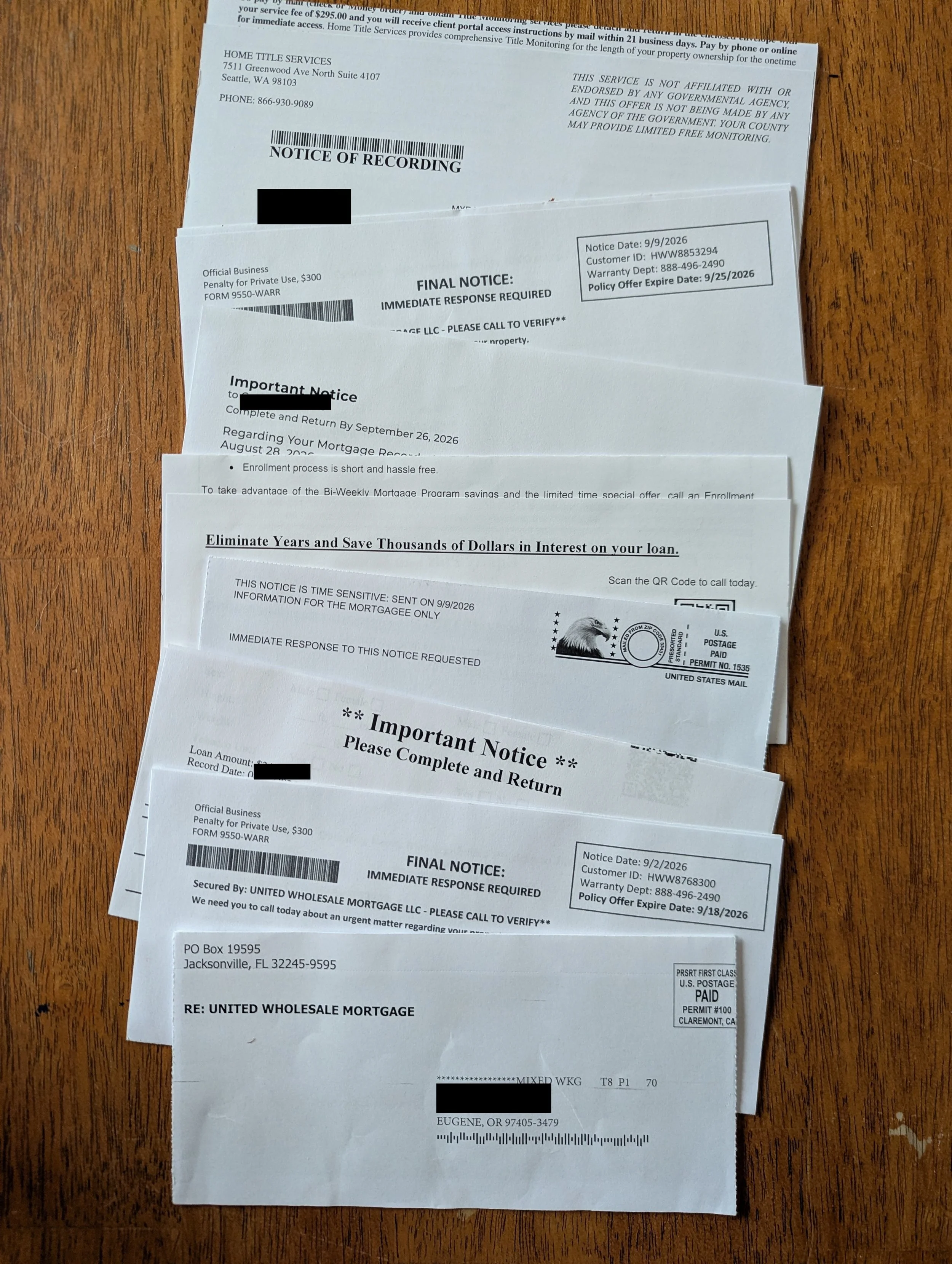
This is a picture of eight pieces of mail that a recent client of mine received shortly after closing on her first home, all trying to sell her needed ‘services’ by presenting themselves as affiliated with the transaction, connected with the lender, or impersonating a government office. She reached out to me, as many others in her position have, to make sure that they were not genuine. The true volume was at least twice this, and these are only the ones that arrive by mail.
Scams and impersonations are a plague on the homebuying process, and they have only gotten more slick, less detectible, and more bold with the rise of AI. I wanted to put out a warning to all who may buy in the near future, or know others who will, to help protect yourselves against the onslaught. These mailings are of the tame variety compared to what else is out there.
What are the latest schemes to be aware of, and how do you protect yourself and others? Let’s walk through some of the major ones in order of where they happen in the homebuying process.
Scam 1: Fake Listings

While listing a home far under its market value to generate views, tours and offers is becoming a common practice in high-priced markets like the Bay Area, this scam is more sinister:
Here a scammer will take photos and description from an expired listing and post a home as ‘For Sale By Owner’. When an interested buyer reaches out, the ‘seller’ says that they relocated for work, can’t show it in person, has a lot of interest already, and will hold the property for a deposit or application fee sent by some digital means. Once a payment is made, the ‘seller’ disappears. The actual owner never knew that anything happened.
This is very common in rental markets, but happening more in sales as well. I had one rental listing last year and was contacted by a person who had been scammed by a spoof of my listing on another site. She had been pre-approved, signed a fake lease, paid her deposit, and was ready to move in when the scammer stopped responding. She found my info on another site and thought I was who she had been talking with. It broke my heart to tell her that she hadn’t actually been talking with the owner of the house and she had lost her deposit.
Because the home isn’t actually listed for sale on the MLS, it won’t show up on the big sites like Zillow, Redfin, Realtor.com, etc.. but they will often post on Craigslist, FB Marketplace and others. Those who are most vulnerable are those who are looking for a screaming deal, those in hot markets, folks who are first-time buyers and may not be able to qualify for a mortgage normally whom the ‘seller’ says can get around the system by working directly with them.
How to protect yourself?
Don’t go chasing waterfalls, stick to the rivers and lakes that you’re used to. The big sites show the on-market listings and this scam won’t work there.
Confirm the details on another site. If the listing states an agent’s name, contact them directly from their own website.
If you do shop in the FSBO world, never pay a deposit or fee before an in-person showing, and never via a non-reversible method like crypto, wire, or gift card. Walk away from someone who can’t meet or presses you with urgency.
Scam 2: Fake Lenders
In the wake of the Great Financial Crisis of 2008, the lending industry has been regulated far more heavily, mostly to the great benefit of the consumer. But opportunists and scammers still lurk on the fringes.
The common scenario targets folks with rough credit histories or little prospect of qualifying for a traditional mortgage. An advertisement on social media will promise a low rate and guaranteed approval fast. The ‘loan officer’ is friendly and fast, and approval comes with little-to-no paperwork and a fake loan estimate. Then there is a request for a $1500 ‘rate lock and processing fee’ or another for ‘mandatory insurance’. Once the payment is made, the ‘loan officer’ disappears, along with their website.
Real upstanding lenders and mortgage brokers (like yours truly <flashes smile>) get paid ONLY when a transaction closes. Scammers want to be paid as soon as possible and target would-be buyers who have the fewest options.
Yes, a real lender will charge for an appraisal before closing, but that will come much further in the process and after a lot of verification.
How to protect yourself?
Check the loan officer’s NMLS number with their consumer database.
Be wary of anyone promising guaranteed approval (prohibited by law), pressuring you to act quickly, or pay anything before receiving a full Loan Estimate (complete with all fees included)
Talk with me! I’ll let you know if you can truly qualify for or afford a mortgage.
Scam 3: Fees on Fees on Fees on ….

This one isn’t a ‘scam’ per se, but a deceptive practice I see too often among lenders, especially the large, online ones like Rocket, Quicken, Better, etc..
A buyer engages with an ad or searches online for the best mortgage. They start a conversation with someone (or nowadays, an AI agent) at a call center at one of the large lenders. They’re quoted a great rate over the phone or via email and sign an engagement contract to work with that lender. Only after the rate has been locked does the official Loan Estimate show how many points or fees it costs to get to that great rate, or that the quoted rate is only temporary. Some of those fees are tucked away in obscure names, some are out in the open. Since the buyer has signed an agreement (or thinks they have), they feel that they have no choice but to move forward with that lender, even though the deal is much worse than they originally thought.
How to protect yourself?
Work with a local broker (like me <flashes million-dollar smile>). We have better rates and terms in general, and we’re also more accountable to the client than a large lender
Remember that you’re never locked in with a lender until you close. This isn’t an invitation to rate shop until the last minute; you do need to stick to one lender for the last two weeks or so to make sure that a transaction closes on-time. But you are NOT legally bound to work with a company that is changing the terms as they go. Nothing you sign before closing ties you to one lender.
A reputable lender (like me <flashes smile so bright the sun gives up>) will be able to explain every cost in a Loan Estimate without stammering, and tell you in plain English, why it’s there. We are not legally allowed to charge more in fees after the initial Loan Estimate, though some costs fluctuate as the transaction moves forward.
Scam 4: Faulty Wiring
This is where the most damage is done. I haven’t had this happen to me or any of my clients, but I’ve heard stories of tens- and hundreds-of-thousands of dollars disappearing, so the stakes is high.
This scenario plays out where a buyer under contract is contacted by the escrow company with wire instructions to send money, either for the earnest deposit or the final payment amount. The buyer complies and wires the money, but the account was fake. The scammer had hacked the account of either the buyer or the escrow company and spoofed an email to the buyer at a critical moment with fake wiring instructions to a separate account. If a complaint is filed quickly, sometimes money can be recovered, but often it cannot as it’s already been moved on to a different account, often in a different country.
I have the conversation with my clients at the beginning of each transaction about the dangers of wiring money. The most vulnerable are those who are tired and impatient at the end of a long transaction or under the pressure of a deadline.
How do you protect yourself?
Never wire money based on emailed wire instructions, and never follow a link in an email about wire instructions. Always call the escrow company directly (talk to the escrow officer that you know) and get the instructions over the phone. Confirm everything twice and make sure all of the details make sense to your transaction.
Don’t discuss financial details over public wifi
If you feel that you may have been scammed, call your bank right away and ask for a wire recall, then file a report with the FBI at IC3.gov and notify the title company.
Scam 5: Doing the Deed
Now we’re back to the pile of mail at the top of this newsletter.
Mail will begin to arrive within days of a transaction, looking as official as possible (possibly impersonating the county clerk) and using language stating action is ‘URGENT’. The letter or envelope will reference the lender, the address, or parcel number, which are all a matter of public record. They will offer mortgage or deed ‘protection’ for a small fee. Sometimes the scammer will impersonate your lender, stating that your loan has transferred to a new servicer (which happens often and is legitimate), that your recent payment failed and with new payment instructions that lead to a spoof website.
Vulnerable parties are often new homeowners wary of missing any sort of payment on their new house.
How to protect yourself?
Call me! <flashes a smile so bright that Crest goes bankrupt> I’ll happily tell you what is real and what isn’t. Many of my clients call me juuuuust to be sure.
Treat unsolicited mail with high suspicion. Don’t pay anything without double-checking with the entity in question
Get an owner’s title insurance policy (often paid for by the seller)
Treat any link in an email from your ‘lender’ with suspicion. Type the lender’s name in manually and bookmark that site.
Conclusion: What to do?

Every scam preys on urgency and a channel you didn’t verify. This is countered by slowing down, taking a breath, and taking the extra step to confirm through a number or website you found yourself. A two-minute pause costs a lot less than a mortgage payment or earnest-money deposit. Think before you act, or call me <flashes a smile so bright it triggers the Apocalypse>