Don’t Trade on Me (Zillow is not Reality)
Video version of this blog here: https://youtu.be/ZM_yafqH0B8

Hi, my name is Chris, and I’m a Zillow junkie.
As an investor and lender, I’m always scrolling or browsing to see what is new to the market or what listing just cut its price or went pending over the weekend. When I’m traveling for work or vacation, I’m checking real estate prices as I browse for second/third/tenth homes. Even with all of the other tools at my disposal, it’s where I start every search, so I write this newsletter from a place of love.
And Zillow is truly a wonder. Just a scant 20 years ago prior to its 2006 launch, there was no place online to see all of the listings in an area. Various local MLS’s (Multiple Listing Services) would have their own listings, often nowhere on the God’s green internet, contributing to fragmented market share all over the country. Real estate record-keeping is an extremely local activity, housed in county and city records offices. Zillow brought housing into the internet age and aggregated all of this data to provide home buyers and renters a way to see all that was available in a given area, with enough property-level data scrubbed at the county level and augmented to give a great user experience.
But what Zillow cannot do, even though it is the main thing users want, is to tell you how much a house (often yours) is worth. With all of the data and high-powered compute behind Zillow, why can’t they do that? Part of the problem is Zillow and part of it is us, humble meat puppets.
Why Zillow is not Reality
How much is a home worth? Exactly what an arms-length buyer is willing to pay for it, full stop. The only way to find out how much someone will pay for it is to FAFO; put it up for sale and see what buyer emerges . I don’t pray at the Church of Capitalism, but a free market is pretty damn efficient at doing this. And Zillow helps improve the efficiency, by being able to broadcast a home offering to everyone with an internet connection and giving data as insight to potential buyers. Zillow also collects heckabytes of data about past and current sales to keep its algorithms up-to-date.
Data analysis is great at providing averages for large sets of information. Zillow has a ton of data about home sales (date, SF, lot size, etc..) that it can use to build models that interpolate those data points to guess at the value of another data point.
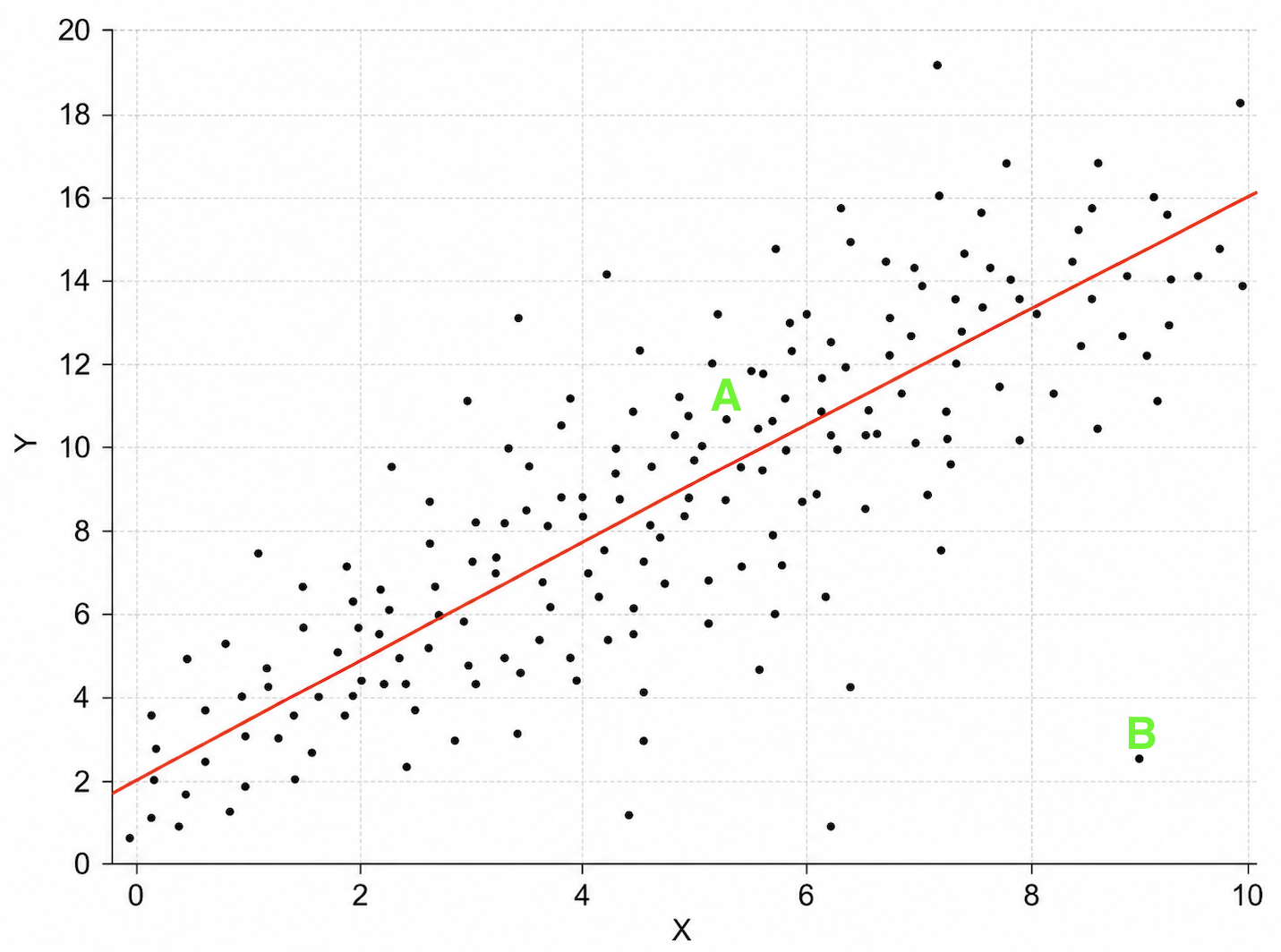
The closer a home is to others in those factors (sale date, SF, lot size, etc..), the closer it is to that red trendline, the easier it will be to determine its value. So a cookie-cutter new build home in a large subdivision with dozens of identical houses on nearly identical lots sold within the last year (Point A) will be easier to value than a 1970’s ranch on acreage that’s still held by the original owner with a converted attic and various ‘remodels’ over the years (Point B).
Zillow Can’t Smell the Cat Pee
But you, handsome reader with chiseled features, are not a cookie-cutter specimen. You are a special snowflake and your house reflects your individuality. You are an outlier that no algorithm can value.
There are so many factors that go into a home’s value that are hard to measure. How old is the roof or the water heater? Quiet street or thoroughfare? 7’6” or 9’ ceilings? Is that ‘bedroom’ really a closet with aspirations? Does the garage smell like cat pee?
So many ingredients in the sangria of a home’s value, how could a computer ever put a number to? Can robots learn to love?
Are We Asking Robots to Love?
While AI will help to analyze photos and descriptions and probably get better at fitting those trendlines to new data, the other reason we can’t rely on Zillow to give us a home value is… us. We ask the algorithm to give us the impossible: accuracy with certainty. But we can’t handle cold, hard estimates so we construct our own interior narrative that paints a rosier picture for ourselves.
The Anchoring Effect
All humans are susceptible to mentally latch on to the first number that we see, or often the number that seems to confirm our optimism.
An experiment in a marketing class years ago highlighted how we subconsciously anchor, even with unrelated data. The class was given a sheet of paper asking us to read a description of a bottle of wine and asked to read the brief and propose a retail price. As an identifier, we were asked to write the first digits of our SSN at the top. We didn’t know at the time, but half the class were asked for the first two digits, and the other half three digits. When the papers were collected and tallied, those who wrote three digits at the top priced the bottle 10-15% higher on average than those who only wrote two. Just writing a larger number on paper caused our brains to anchor to a higher value of the fictional bottle.
And we do the same thing with home prices. We look at the highest prices in our neighborhood and subconsciously apply them to our house. We hear about a neighbor who sold in 2021 for $X and think that our house should obviously be worth $(X+). We often do this without thinking and those beliefs about our home’s value get stored in our emotional memory, making them very hard to let go.
Precision =/= Accuracy =/= Certainty
Zillow is the largest real estate company that we interact with regularly and they have earned a position of authority in our collective consciousness. When they present a home value estimate, we expect that that number has the backing of a huge company with lots of computers. We have a tendency to trust numbers when they look official.
Because the estimate comes wrapped in a clean interface, attached to a specific dollar amount, and delivered by a company everyone recognizes, it feels more authoritative than it really is. A paragraph full of caveats feels squishy. A dollar amount with commas feels like truth. It is precision that we mistake for accuracy. Zillow doesn’t tell me my house is worth “around $490k”, it tells me my house is worth $487,700. (I think it’s worth more, fwiw)
It’s the black-and-white value that looks authoritative that gives the air of certainty, and we latch onto that. But Zillow has very little at stake when presenting you that estimate. It isn’t an appraiser held to professional standards, or an agent spending their time with a client, or a lender reviewing collateral risk or a buyer pledging their own money in an offer. They’re not the ones with money on the line, you are.
Ironically, Zillow doesn’t even trust its own valuations anymore.
The Collapse of Zillow Offers
In the mid-2010’s, Zillow launched Zillow Offers, an “iBuying” wing of the company that would put an offer on a home that its models felt was under-valued and needed some work to fix up. They would make the repairs and relist the home at a value it felt the market would support. They bought thousands of houses with the expectation that their numbers were better than everyone else’s and they could profit from market mispricings.
But their algorithms weren’t able to correctly identify mispricings in the market, or make offers that gave them enough margin to turn a profit on the flip at their expected after-repair value. They put their money where (the algorithm told them that) their mouth was and hit their ear. Over and over and over again, until shutting the division down in 2021. They eventually lost $569M in the experiment, an average of $30k loss per property.
If Zillow doesn’t even trust their own numbers when actual Benjamins are on the line, why should you?

The Zillow Safety Course
You have the constitutional right to bear arms, but bearing arms stupidly can lead to shooting yourself in the foot. You have Zillow on your phone, but trusting it implicitly can lead to great financial injury. So how do I use Zillow responsibly?
Do not expect certainty. Zillow’s estimate is a flashlight we mistake for a laser. Think of the Zestimate as a putting green, where the pin could be close to the center, or it could be off on the side near the bunker.
Recognize how far your (or any) house is from the medium for the market and reduce your expectations of accuracy the further you stray from God (Lennar).
Don’t put your money/time/effort into any property until you’ve conferred with a professional (like me, I’m a professional).
How do I actually value my house?
The only surefire way to find out what your home is worth is to put it on the market. But that’s laborious and you don’t want to move every week, so what else can you do?
At the most basic and free, at least triangulate between Zillow, Redfin, Realtor.com and any number of other services. If I’m looking to do a quick-math valuation, I use PropStream (a paid service) to look at recent comparable sales in the area and get a range of price-per-square-foot values, then look at pictures of those sales to see where in that range my property might fall. I can do that in 10 minutes for a property that I’m interested in, then if the numbers look good, I move on to the next step:
Talk to a real estate agent, and possibly get a CMA (Comparable Market Analysis). That takes my moves from Step 1 and fleshes them out even further. They take several hours and should only be requested when you’re serious about buying or selling. Once you are serious enough to list a home or put in an offer, the final step in valuation is an appraisal.
An appraisal is required by any non-hard-money lender as a way to measure collateral risk. They are more art than science and tend to reflect (sometimes exactly) what the agreed-upon purchase price is. Why? Because that is the strongest signal of value that there is, short of a completed sale.
The market has spoken! We must listen! All Hail the Invisible Hand!